
Bioceramic White Papers
Himed engages in regular research about biomaterial coatings, apatitic abrasives, and calcium phosphate characterization. Select research is published as white papers, and made available for download below.
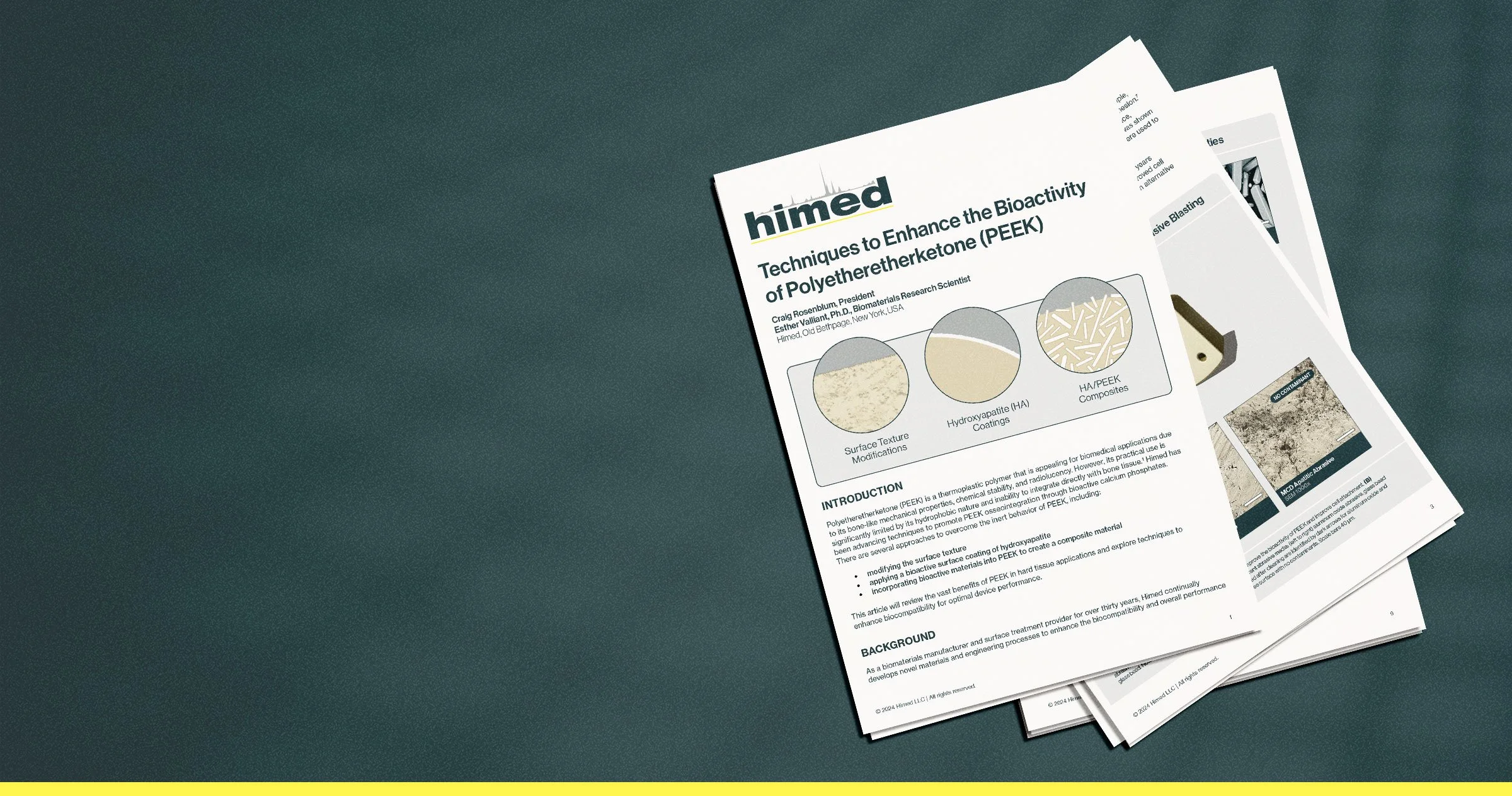
Techniques to Enhance the Bioactivity of
Polyetheretherketone (PEEK)
AUTHORS:
Esther Valliant, PhD | Himed Biomaterials Scientist
Craig Rosenblum | Himed President
Polyetheretherketone (PEEK) is a thermoplastic polymer that is appealing for biomedical applications due to its bone-like mechanical properties, chemical stability, and radiolucency. However, its practical use is significantly limited by its hydrophobic nature and inability to integrate directly with bone tissue.
To overcome these functional barriers, Himed has been advancing techniques to promote PEEK osseointegration through the use of bioactive calcium phosphates.
In this white paper, Himed details three methodologies for introducing greater biocompatibility to PEEK, citing dozens of studies in the process, to support medical device designers and materials engineers in improving the efficacy of polymer-based implantable devices
-
Micro-abrasive blasting with a resorbable blast media of biphasic calcium phosphate can increase the roughness of commercially available PEEK, shifting the surface from bioinert to biocompatible.
-
Coatings of hydroxyapatite (HA) maintain the mechanical properties of the bulk polymer, but change the surface properties that interact with the body. Himed’s MATRIX HA® uses an atmospheric plasma spray to apply a dense, osteoconductive, HA coating.
-
The particle morphology of calcium phosphate biomaterials can impact the biological and mechanical properties of PEEK composites significantly. The method of manufacture can impact particle properties, and a number of different forms, including Himed’s unique rod-like HA whiskers.
REQUEST PEEK WHITE PAPER

Finishing 3D Printed Devices with
MATRIX MCD® Apatitic Abrasive
AUTHOR:
Craig Rosenblum | Himed President
While 3D printing has transformed the rapid production of intricate implantable devices, post-process finishing is often a necessity for critical improvements to the aesthetic appearance and overall functionality. This whitepaper offers three case studies to demonstrate the various advantages of Himed’s biocompatible MATRIX MCD® Apatitic Abrasive micro-blasting, including: the removal of residual beads and surface imperfections (Case Study #1 & #2), and functional benefits via quantification of the post-processed surface profile, surface roughness, and related areal parameters (Case Study #3).
REQUEST MATRIX MCD® WHITE PAPER
MATRIX Dual® Expands Micro-Scale Morphology
Potential of Orthopedic Implants
AUTHOR:
Craig Rosenblum | Himed President
As the medical industry continues to explore the conditions for successful implant integration with the human body, closer attention is being paid to the surface morphology of a given device. In this white paper, four case studies are reviewed that use advanced scanning technology to characterize—at the submicron and nanoscale level—implant surfaces treated with our two-step MATRIX Dual® process.
The studies reveal the positive benefits delivered by MATRIX Dual®, including highly complex micro and macro pitting, freedom from contamination, and fidelity to the size, shape, and function of the original device after treatment.
REQUEST MATRIX DUAL® WHITE PAPER